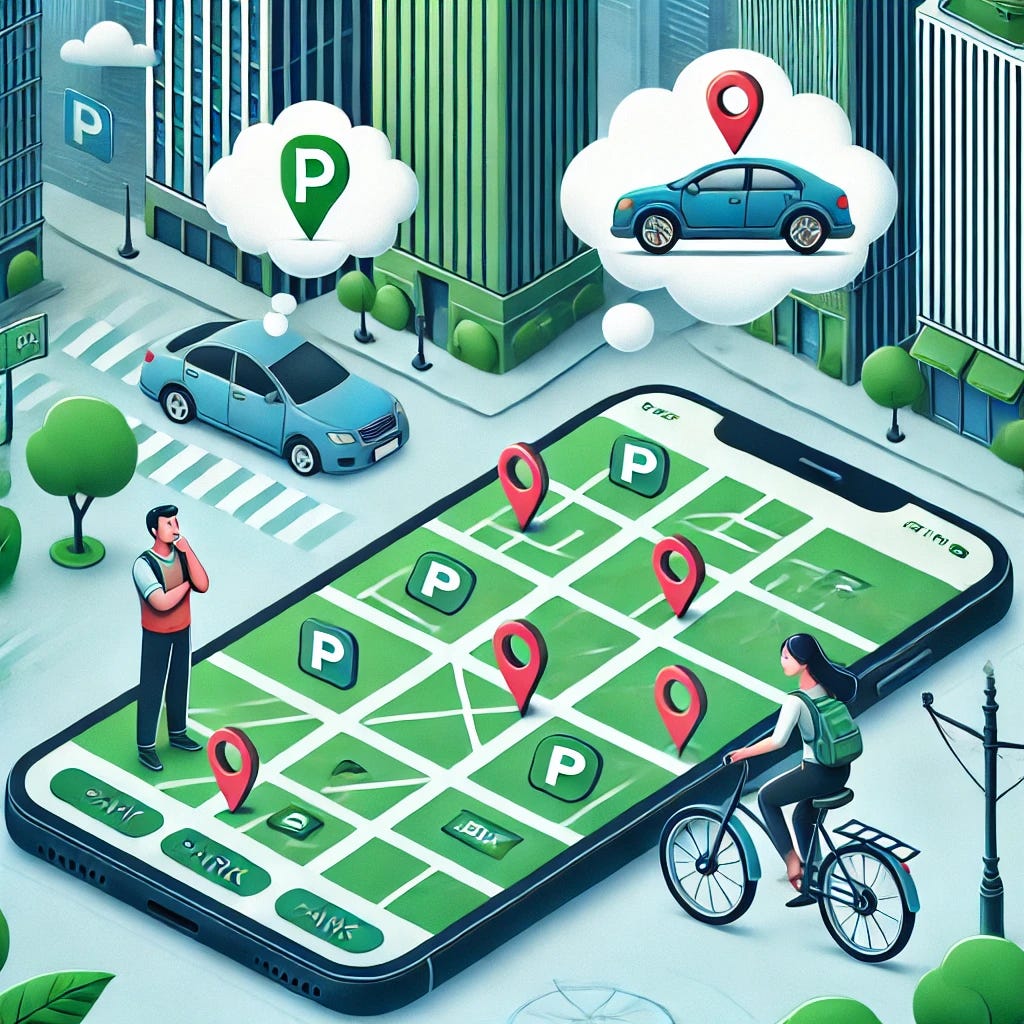
Interview Prep Alert: "How to Design a Parking Product?"
This is a real Interview question asked in Meta in 2024. This Article list down probable way of answering this question. It is explained in depth, and with frame. Join the waitlist to solve live!

Hey, Aspiring Product Managers!
Today, we’re breaking down a real PM interview question:
“You are a Google Maps PM or Apple Maps PM. Design a product for parking.”
Let’s explore this question as a case study and walk through how you’d approach it in an interview. We'll also break down which category of product interview questions this fits into and why. By the end of this, you'll have a better sense of how to think through such product problems—like a true product leader!
Category: Product Design Question
This question falls squarely into the Product Design category, which is one of the most critical parts of PM interviews. In this category, interviewers want to see how you think about user needs, problem-solving, and feature prioritization while considering technical constraints and business goals.
Product design questions often ask you to build or improve a product that solves a real-world problem.
In this case, it's parking—a common pain point for users of navigation apps.
Hey, I’m Abhik here.
Helping Aspiring Professionals and PM’s to 5x their, Product Career & Job Search
Subscribe and Join the Waitlist for Invite Only Community,
where we solve these real Product Interview Questions Live, with Me,
Breaking Down the Question
When you’re asked to design a product, especially something as seemingly simple as parking, the interviewer is looking for
structured thinking and how you handle ambiguity.
Here’s how to approach this:
1. Clarify the Problem
Before jumping into solutions, ask clarifying questions to narrow the scope:
Target audience: Who are we solving for? Is it for everyday drivers, delivery drivers, or businesses?
Geography: Are we focusing on urban areas where parking is a challenge, or is this global?
Scope: Are we solving just for finding parking, or also for payments, reservations, or enforcement?
Integration: Is this a standalone feature, or should it integrate seamlessly into existing navigation tools like Google Maps or Apple Maps?
The key here is to fully understand the scope and the constraints of the problem. Parking is a broad issue, and the solution will depend on who and where the users are.
2. Identify User Personas
Let’s outline a few key user personas for this product:
Commuter Drivers: These users drive to work daily and need parking that’s easy to find, affordable, and near their destination.
Tourists/New Drivers: They are unfamiliar with the area and want a reliable way to find parking near attractions.
Delivery Drivers/Professionals: They have strict time constraints and need quick, accessible parking to meet deadlines.
EV Drivers: They need parking that also offers charging stations, adding another layer of complexity.
For each persona, parking is not just about location but also time, cost, and convenience. Understanding the different needs of each user group helps you prioritize features later.
3. Map Out User Pain Points
Now that we know who our users are, what problems do they face?
Availability: Finding a spot quickly, especially in crowded cities.
Cost: Ensuring the parking is affordable.
Proximity: Parking near their destination.
Time Efficiency: Reducing the time spent looking for parking.
Integration: Making payments easy and quick, ideally within the app.
These are the core pain points that your product needs to address.
4. Define the Success Metrics ( other may call North Star Metrics)
For a parking product, a possible Success Metric could be:
Time to Park: How long does it take a user to find a spot from when they arrive at their destination?
Parking Success Rate: The percentage of users who find parking within X minutes of searching.
Both metrics indicate how well your product is solving the key pain points around availability and efficiency.
5. Generate Solutions
Here’s where your creativity comes into play!
How can we design a product that solves the parking problem for these users?
Feature Set 1: Parking Discovery
Real-Time Parking Availability: Show real-time availability of parking spots (both street and garage) on the map.
Predictive Parking: Use machine learning to predict parking availability based on time, weather, and events in the area.
Reserve Parking: Allow users to reserve spots in advance, eliminating uncertainty.
Feature Set 2: Payment Integration
In-App Payments: Enable seamless payments for parking (both hourly and flat rate) directly within Google Maps or Apple Maps.
Parking Pass Subscription: Offer a monthly parking pass for frequent users, providing access to premium spots or discounted rates.
Feature Set 3: Contextual Parking Suggestions
Parking Based on Preferences: Allow users to set preferences (e.g., distance from destination, cost cap, electric vehicle charging availability) and provide personalized suggestions.
Guided Parking Routes: Offer real-time navigation to available parking spots, with turn-by-turn directions.
Feature Set 4: EV-Specific Features
EV Charging Spot Finder: Show parking spots that have EV charging stations and whether they are available.
6. Prioritize the Features
Not every feature can be developed at once, so how do you prioritize?
Start with the most impactful and easy-to-deploy features:
Phase 1: Real-Time Parking Availability and In-App Payments. These features solve the core user problems of finding and paying for parking quickly.
Phase 2: Predictive Parking and Reserve Parking to make the experience smoother for regular users.
Phase 3: Parking Pass Subscription and EV Charging Spot Finder to cater to niche audiences and premium users.
Use metrics like time saved and user adoption to assess the success of each feature rollout.
7. Consider Technical Feasibility
It’s important to acknowledge the technical challenges:
Data Aggregation: Gathering real-time data from parking garages and city sensors is complex but essential.
Machine Learning Models: Predictive parking requires historical data, weather, and event information.
Partnerships: You may need to partner with municipalities and private garages to offer reservations and real-time availability.
These factors can help guide the technical roadmap and prioritization.
Why This Approach Matters
Product design questions test how you think about problems from both a user-centric and business-driven perspective. Interviewers want to see you:
Break down the problem into user needs.
Prioritize features based on impact and feasibility.
Design solutions that align with business goals (e.g., revenue from parking fees, increasing app engagement).
By showing structured thinking, deep empathy for users, and an understanding of the technical landscape, you'll demonstrate the skills needed to lead product innovation.
Takeaways In today’s newsletter, we covered:
How to break down a parking-related product design question.
Identifying key personas and pain points.
Generating practical, user-centric solutions.
Prioritizing features for maximum impact.
Navigating technical and business constraints.
Next time you face a product design question, think deeply about the users, frame the problem clearly, and craft solutions that deliver real value. Keep honing your skills, and soon you’ll be navigating PM interviews with ease!
Until next time, Abhik Chowdhury
Don’t miss to join the waitlist for Closed Community and Live Session for solvinf the real questions.